
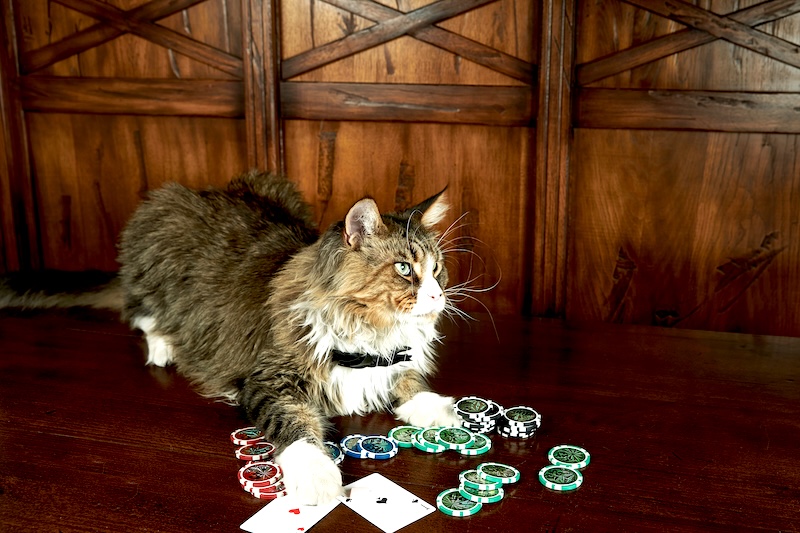
From Depositphotos.
“Every decision is a bet.” That’s what Annie Duke says in her book, Thinking in Bets. Annie Duke, a highly successful poker player, sees the world through the lens of a poker game…and that view might actually be helpful.
I thought about that when I saw today’s advice column from Carolyn Hax of the Washington Post. It seems to be about managing a relationship, but we’re really looking at the outcome of a bet.
The LW was a long-married woman who has grown apart from her husband. In their early days as a couple, they would patronize the arts and read challenging books. Now he watches television and reads thrillers. He doesn’t want to join her on cultural expeditions.
Readers suggested she stop trying to change him and continue her interests on her own or with a female friend.
I say the LW made her bet when she chose her husband. It sounds like she made a good decision based on her experience at the time. But, as Annie Duke says, you can have a good decision with a negative outcome, or vice versa.
I sympathized with the LW. She was betting on an outcome involving shared cultural interests. That has nothing to do with occupation or formal education, but with a certain amount of curiosity and mental energy.
But I also think of people I know who wistfully think, “I’m happy being single, but I’d love to have a partner to communicate my dreams, hopes, and fears.”
The problem is that partners change. They develop new interests that freeze out their partners. In extreme cases, we read of people saying, “He’d never do that…but he did.” Or, “She seems like a different person.”
So when you begin any kind of relationship, you’re placing a bet. You’re betting they’ll be available to support you emotionally and share your experiences.
When a relationship partner changes, you decide if the relationship is worth saving. I don’t know what to say about married people whose partners change dramatically; there are nuances to marriage we single people will never understand.
Annie Duke reminds us:
“A great poker player who has a good-size advantage over the other players at the table, making significantly better strategic decisions, will still be losing over 40% of the time at the end of eight hours of play.”
You can get better but you’ll never be 100%. And an unlikely outcome can occur: if there’s just a 20% chance an outcome could occur, that’s not the same as 0%.
We have many possibilities and few guarantees. It doesn’t mean we stop betting if we want a full life; after all, poker players place dozens of bets in a single session.
You may have heard the expression “Not to decide is to decide.” If you decide not to have this relationship, or indeed any relationship, you’re betting that single life will be better than the coupled life.
But as long as we remember we’re not seeing certainty but betting on an outcome, we shouldn’t be surprised when that outcome is unexpectedly better or worse than we originally imagined. If we view decisions this way, we’re less likely to beat ourselves up for a bad outcome.
And as far as I’m concerned, it’s perfectly reasonable to celebrate when outcomes exceed our expectations…even though we can be equally surprised.

