
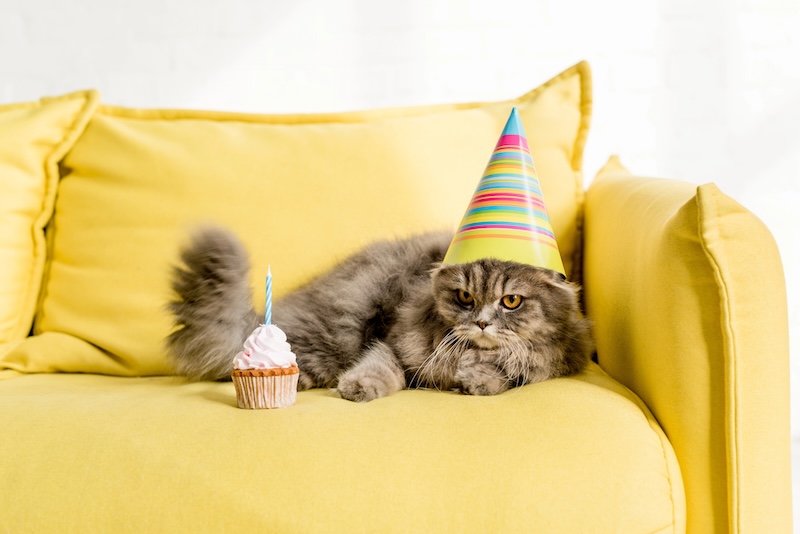
From Depositphotos.
Today I saw an article about how birthdays can be depressing. The author, aging solo, had just gotten some disappointing news from her medical checkup. And she was sad about getting older. She was disappointed not to feel happier.
She’s not alone. Within the last year, I’ve seen countless articles from single people who feel lonely on their birthdays. Nobody called. They got just one card. They felt nobody cared.
These people have responded to cultural expectations about birthdays, much as we have cultural expectations about Thanksgiving, Christmas, and Valentine’s Day.
Some believe that people who resist birthdays have underlying psychological issues, like childhood neglect. I suspect they’re the same people who think there’s something wrong with anyone who refuses invitations because they want to spend the holidays alone.
Birthdays, like holidays, are cultural constructs with cultural baggage from greeting cards to Norman Rockwell paintings. Too often we see them instead as symbols of caring and connection. Some cultures specifically forbid birthday celebrations.
Some celebrate a person’s name day: the saint after whom they were named. So if your name were Andrew or Andrea you’d probably celebrate St. Andrew’s Day, not the day you were born. I rather like that idea: it calls attention to something outside ourselves.
But in some cultures and some families, a birthday can come with a sense that something is owed to them: a day of feeling special. It’s the same feeling as Thanksgiving and Christmas: “I deserve to have a holiday surrounded by loving people who feel I’m part of their community.”
The truth: Many people are alone on holidays and birthdays.
Lots of single people look forward to a solitary Thanksgiving or Christmas. It’s a whole day to be free to spend with our cats and do something for ourselves that we’ll enjoy. We get to miss the family fights and the snarky questions about whether and who we’re dating.
Actually I think the married people want to have some space too. At my barre class last Thanksgiving, half a dozen women openly said they’d sent food to the family but decided to stay home alone.
As for me…
I’ve always been single by choice. And I don’t feel miffed when someone forgets my birthday.
I don’t even announce the day. When forced to write down a date for a non-legal document, I give my former dog’s birthday.
So when I read about single people who feel sad and lonely on their birthdays, here’s what I’d like to tell them.
- Celebrating another year on the planet can have very different meanings.
US culture seems to see birthdays as some combination of accomplishment and gratitude. You made another trip around the sun: you deserve a reward.
Frankly, I don’t get it. If you’ve accomplished another year, it’s rarely due to your own efforts; you won the lottery of genes and luck, avoiding accidents and benefiting from good health care and insurance.
Gratitude? Some people are extremely grateful they got another year of life; maybe they got to do one special thing or spend more time with a special person.
But others are probably not grateful to be one year closer to a nursing home.
Of course some birthdays are milestones for teens, like bar mitzvahs or quinceañeras. Turning eighteen or twenty-one can mean celebrating access to voting, drinking, and other privileges. A birthday at 60 or 65 can signal mandatory retirement, which is greeted with dread or eagerness.
Or for some, it’s just another day.
2. If you’re single, celebrating birthdays will invite snarky comments about society’s age-related expectations for you.
When we hear that someone’s having a birthday, the natural question to ask is, “Which one? How old?”
Ageism exists everywhere. I rarely tell my age because once people know how old you are, all they see is a number. And they put expectations around that number.
Our society creates age-related norms specific to single people. In your twenties, you’re expected to be on the prowl for a mate. A female who turns 35 becomes more open to wisecracks about how the clock is ticking for her child-bearing years (even though she has no desire to have children). A single male who turns 40 gets jokes about being a “carefree bachelor” or a “cat dad.”
Older singles get pitying remarks. A medical tech once said to me sadly, “Too bad you don’t have children to help you.” I decided not to tell her about my friend who has 3 children – one in prison, one estranged, and one living in Thailand.
3. Single people can have more birthdays to keep track of.
As a single person, I don’t celebrate birthdays of a spouse or children. I rarely remember other people’s birthdays. I keep meaning to write them into my Google calendar but rarely get around to it. So I’m not surprised when other people forget my birthday.
I also suspect there’s an innocent reason. Remembering birthdays is easier if you have a finite number of birthdays to remember – a spouse, children and extended family. And they recur year after year.
However, as Bella DePaulo says, married people have the One and single people have the Ones…and our friends can change during our adult life. So we have to track birthdays of a larger group of people who may change from year to year.
Celebrations and cards get triggered by systems that have birthdays logged into the calendar. A Facebook page. An employee roster. A professional’s Rolodex.
So instead of personally chosen, signed cards, you get an automatic message on Facebook. You get a card from the insurance agent or financial planner. It can be a way of saying, “I see you and honor you as a person,” even if everybody knows you were reminded..
Those impersonal reminders can trigger unintended messages. A hospital sent me a note, “Greetings on your birthday! Here are the tests you need to schedule…” followed by a list of tests and then a note: “None of these is needed at your age.” Talk about adding insult to injury…
I’ve found that some people respond to friendly reminders. In communities where I belong, it’s not unusual to have someone say, “My birthday is next week and I’m inviting everyone to come.”
I’ve organized events around my birthday at my coworking space: I bought the cake, planned the event (which last time included some stand-up comedy), and asked for donations to my favorite charities. It was a fundraiser- an occasion for people to eat treats and connect sociably – not about me.
So we can identify multiple ways to negotiate birthdays.
If friends and family bring you cake, candles, and parties, and you want to participate, go for it. If they don’t, many single people I know use the occasion as a reason to treat themselves.
If you want to, take the day off and do something fun. Buy yourself that book, those tickets to a play, that special pair of shoes, even that extra meal or dessert. Need an excuse to splurge? Well, that’s the best part of birthdays, in my opinion.
You don’t have to tell anyone. Just enjoy.
And this list may not apply to you.
Not everyone feels as Scrooge-y as I do about birthdays. Sending birthday wishes, even standardized on a Facebook page, can be a way to say, “I care about you.”
But if you find yourself spending your birthday alone with your dog, there’s no need to ponder the ingratitude of your friends and family.
Making your birthday carry a lot of emotional weight can make people feel lonely and depressed. You don’t have to give it too much power: it’s a cultural artifact you can redefine to suit your life and your lifestyle.

